Manual SEO is fragmented, slow, and hard to execute
Most teams still handle SEO in disconnected steps.
They run a scan in one tool, review warnings somewhere else, compare changes manually, and then translate generic findings into development work. That makes SEO slower than it needs to be and turns routine fixes into a fragmented workflow.
For developers and technical teams, the usual problems are clear:
- issues are found outside the development environment
- warnings are often generic instead of actionable
- tracking what changed between scans takes manual effort
- regressions are easy to miss
- fixing issues means jumping between tools, reports, and code
The result is not just slower SEO work. It is slower execution.
SEOLint turns SEO monitoring into part of the development workflow
SEOLint is an AI SEO agent built for developers and teams working inside Claude-based workflows.
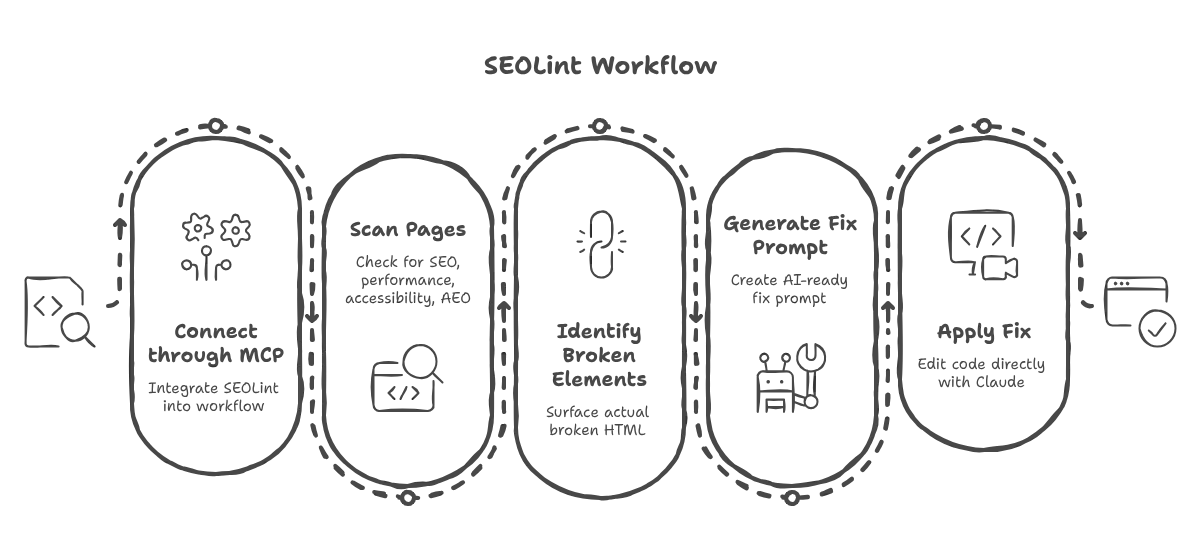
It connects through MCP, scans pages, identifies broken elements, shows the actual HTML where relevant, and generates fix prompts designed for Claude Code and Cursor. Instead of handing you another dashboard to check, it helps move the work from issue detection to implementation inside the same workflow.
It also retains memory across scans, so you can understand what is new, what is fixed, and what has regressed over time.
For teams evaluating AI SEO tools, SEO automation, or automated SEO monitoring, that is the real difference: SEOLint is built for execution, not just reporting.
How it works
What is included
- MCP server
- CLI
- AI fix instructions
- page scanning
- issue tracking across time
- memory across scans
- site intelligence
- content-gap suggestions
- visual screenshot scoring
- 40+ checks across SEO, performance, accessibility, and AEO
1 site under agent watch · $79/mo · agent + MCP included · AI usage covered
Who it is for
SEOLint is built for developers and teams that want SEO work to happen inside their existing development environment.
It is a strong fit for teams who:
- work inside Claude-based workflows
- want a Claude SEO agent instead of another dashboard tool
- need SEO monitoring for developers, not just marketers
- want an SEO agent with memory across scans
- use Claude Code or Cursor and want faster implementation
- need a technical SEO agent that helps turn findings into code-level fixes
- want AI-powered SEO monitoring without constant context switching
If your team already treats performance, accessibility, and code quality as part of the stack, SEOLint fits that same way of working.
Why SEOLint is different
It lives inside Claude
SEOLint is MCP-native, so the work happens inside Claude instead of in a separate dashboard.
It shows the broken HTML
Instead of vague warnings, it helps surface the actual broken element where relevant, making the issue easier to understand and fix.
It is built for implementation
Its fix prompts are designed for Claude Code and Cursor, so the next step is not left to interpretation.
It remembers what changed
SEOLint retains memory across scans, helping teams understand issue history and spot regressions faster.
It covers more than classic SEO checks
It runs 40+ checks across SEO, performance, accessibility, and AEO in one workflow.
It reduces context switching
That matters because faster fixes usually come from fewer handoffs, fewer tools, and clearer execution.
The closing gap between SEO and development
SEO used to be handled like a separate discipline.
A page would go live, someone would audit it later, and then the development work would happen after the fact. That model breaks down when issues need to be found early, tracked across changes, and fixed quickly inside modern shipping cycles.
The gap is no longer between marketing and engineering. The gap is between what is visibly broken on the site and how fast a team can act on it in code.
Missing or broken elements affect how pages are understood, rendered, and surfaced. Weak structure, accessibility issues, and unresolved technical problems do not stay isolated inside a report. They affect discoverability, visibility, and performance.
SEOLint is built to help close that gap.
It treats SEO less like a separate audit process and more like an operational layer inside development. Scan the page, see what changed, understand what is broken, generate the fix prompt, and act on it in the same environment. That is the shift: from manual review across disconnected tools to SEO automation that fits the way developers already work.
Proof and evidence
SEOLint already shows practical workflow proof on the homepage, including:
- scan history over time
- issue states such as NEW, FIXED, and REGRESSED
- content-gap suggestions from sitemap analysis
- a worked example of code editing from detected issues
- featured-on logos shown on the homepage
These are useful proof points because they show how the product works in practice, not just what it claims to do.
Related pages and tools
Explore more of the SEOLint ecosystem:

Start fixing SEO issues inside Claude
SEOLint is built for teams that do not want SEO trapped in reports, dashboards, and disconnected workflows.
If you want an SEO agent that scans pages, remembers context, tracks issue history, and helps turn broken findings into actionable fixes inside Claude, SEOLint is built for that.
FAQ
- What is SEOLint?
- SEOLint is an MCP-native SEO agent inside Claude. It scans websites, tracks issues over time, remembers site context across scans, and generates AI-ready fix prompts that help developers resolve issues in the codebase.
- Who is SEOLint for?
- It is built for developers and teams working inside Claude-based workflows, especially those who want to monitor and fix SEO issues directly inside their development environment.
- Is SEOLint a dashboard-based SEO tool?
- No. One of its main differences is that it is designed to reduce dashboard dependency and context switching by working through MCP inside Claude.
- What kinds of issues does it check?
- SEOLint runs 40+ checks across SEO, performance, accessibility, and AEO.
- How does SEOLint help with fixes?
- It detects issues, shows the broken HTML where relevant, and generates fix prompts designed for Claude Code and Cursor so the issue can be acted on more directly.
- Does it track changes over time?
- Yes. SEOLint retains memory across scans so you can see which issues are new, fixed, or regressed.
- What comes with every plan?
- Every plan includes the MCP server, CLI, and AI fix instructions, along with page scanning, issue tracking, and memory across scans.
- Is SEOLint useful for teams evaluating AI SEO tools?
- Yes. It is especially relevant for teams looking for AI SEO tools, SEO automation, automated SEO analysis, or automated SEO monitoring that fits inside a development workflow rather than sitting outside it.
- Can SEOLint support ongoing monitoring?
- Yes. It is designed for ongoing scans and issue tracking, not just one-time analysis.
- What is the biggest reason to choose SEOLint?
- The main advantage is workflow fit. SEOLint helps developers scan, understand, track, and fix SEO issues inside Claude, with memory across scans and a clearer path from detection to implementation.